Skip to content

Obsidian Detailing — Building a local detailing site for trust, clarity, and bookings

Obsidian Detailing is a live, owner-operated business inside the wider Obsidian ecosystem. This case study matters because it shows the approach in a real service-business setting: make the business feel more premium, make the packages easier to understand, and make it easier for local customers to enquire from a phone.

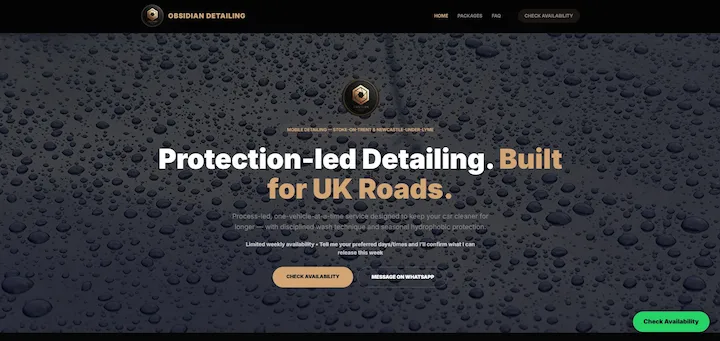
Obsidian Detailing website preview

Live business project

Project summary

Business Local detailing business
Goal Improve trust, package clarity, and local enquiry flow
Focus Premium positioning, mobile UX, and conversion structure

What this proves: many local service businesses do not need more visual noise. They need a site that feels more trustworthy, explains the offer more clearly, and reduces hesitation before the enquiry happens.

The problem

Compete on trust and quality, not just price.

A lot of local detailing businesses end up looking interchangeable online: unclear packages, weak presentation, too much text, poor mobile flow, and too much reliance on price comparison.

That creates hesitation. People are left working too hard to understand what is included, whether the business feels premium enough, and what they should do next.

The goal here was to remove that friction: make Obsidian Detailing look more established, make the packages easier to understand, and reduce the gap between first visit and first enquiry.

What needed to change

The site had to do a better job of helping customers decide.

Package clarity

Services needed to be easier to compare, with clearer explanations of what was included, who each option suited, and why one package should be chosen over another.

Premium trust

The visual presentation had to support higher perceived quality so the business was not forced into a race to the bottom on price.

Mobile contact flow

A lot of visitors arrive on their phone, so the contact path needed to feel immediate, simple, and low-friction instead of buried.

How the site was structured

Each section has a specific commercial job.

  • Hero section: quickly explains the business, frames the quality level, and gives a clear next action.
  • Packages: breaks services into simpler, more understandable options so visitors can compare without friction.
  • Trust sections: uses visuals, reassurance, and cleaner presentation to support premium positioning.
  • Contact path: keeps WhatsApp, phone, and enquiry actions easy to reach on mobile, where a lot of local intent happens.

The point was not to add more sections for the sake of it. The point was to make the site easier to trust and easier to act on.

Build decisions that mattered

This is where the site earns its keep.

Cleaner service hierarchy

Instead of burying people in a wall of text, the service structure helps visitors understand the offer faster and decide more confidently.

Faster media handling

Images were handled carefully so the site still feels visual and premium without dragging performance down on mobile.

Local intent support

The site was written and structured to support nearby customers who are already looking for detailing and comparing options.

Technical foundations

Not the headline feature, but part of the standard.

  • Lean front-end build with unnecessary weight stripped out
  • Compressed images and modern formats to support mobile performance
  • Clear semantic structure to support accessibility and crawlability
  • Performance-conscious loading choices to reduce friction on real devices

Strong technical foundations do not replace good positioning and offer clarity, but they stop the site from fighting against them.

Commercial takeaway

Obsidian Detailing shows the approach in a real service-business setting: improve the first impression, make the offer easier to understand, and make the route to enquiry simpler on mobile.

The underlying lesson is not “this works for detailing only.” The lesson is that many local service businesses lose trust and action through the same problems: weak positioning, confusing packages, thin trust signals, and poor mobile contact flow.

This project proves that the job is not just to make a website look better. The job is to make the business easier to trust and easier to contact.

Related proof

If you want to see more of the thinking behind the build, these are the next places to go.